
From Cattle to Conservation: The Jacobsen Story
As spring makes its final descent across Sonoma County, we see the pace increase on our working lands: the farms, ranches and people who shape this place we call home. We are honored to feature Anna Jacobsen, whose family’s ranching legacy is woven into the fabric of Sonoma County. Her story is one of stewardship, community and connection to the land across generations.
Growing up in the ranchlands of Sonoma County was not just where she was raised, it was something Anna belonged to. A rhythm shaped long before her, carried forward by the hands and hearts of her family, the Jacobsens.
That story began far from the rolling hills she calls home. Her great grandparents Anna and Jacob Jacobsen came from Denmark in the early 1900s, landing first in New York City before eventually making their way west to Petaluma. Back then, Sonoma County looked different. Chickens, not cattle or vineyards, defined the landscape. Petaluma was known as the “egg basket of the state.”
But Jacob saw something more. He began traveling north to Ferndale, buying dairy cows and hauling them south to Bay Area markets. Those early trips were long and often exhausting, including driving cattle trucks across the Golden Gate Bridge, likely the first for anyone in the region. Anna was a homesteader through and through. A tremendous baker and preserver of local produce in the area and on the farm. It was hard work, the kind that asks everything of you.
Over time, the family put down deeper roots in Petaluma. Ranch by ranch, they built a life in beef cattle, working side by side, Jacob, her grandfather Elray and his wife Ruthelma, and her great uncle Walt, who owned the West Petaluma property later conserved with Ag + Open Space. Together, they shared the kind of labor that fills your days and follows you home at night. What they built was not just a business. It was a way of being, grounded in grit, shaped by change, and tied closely to the land beneath their feet.
That connection only deepened in the next generation.
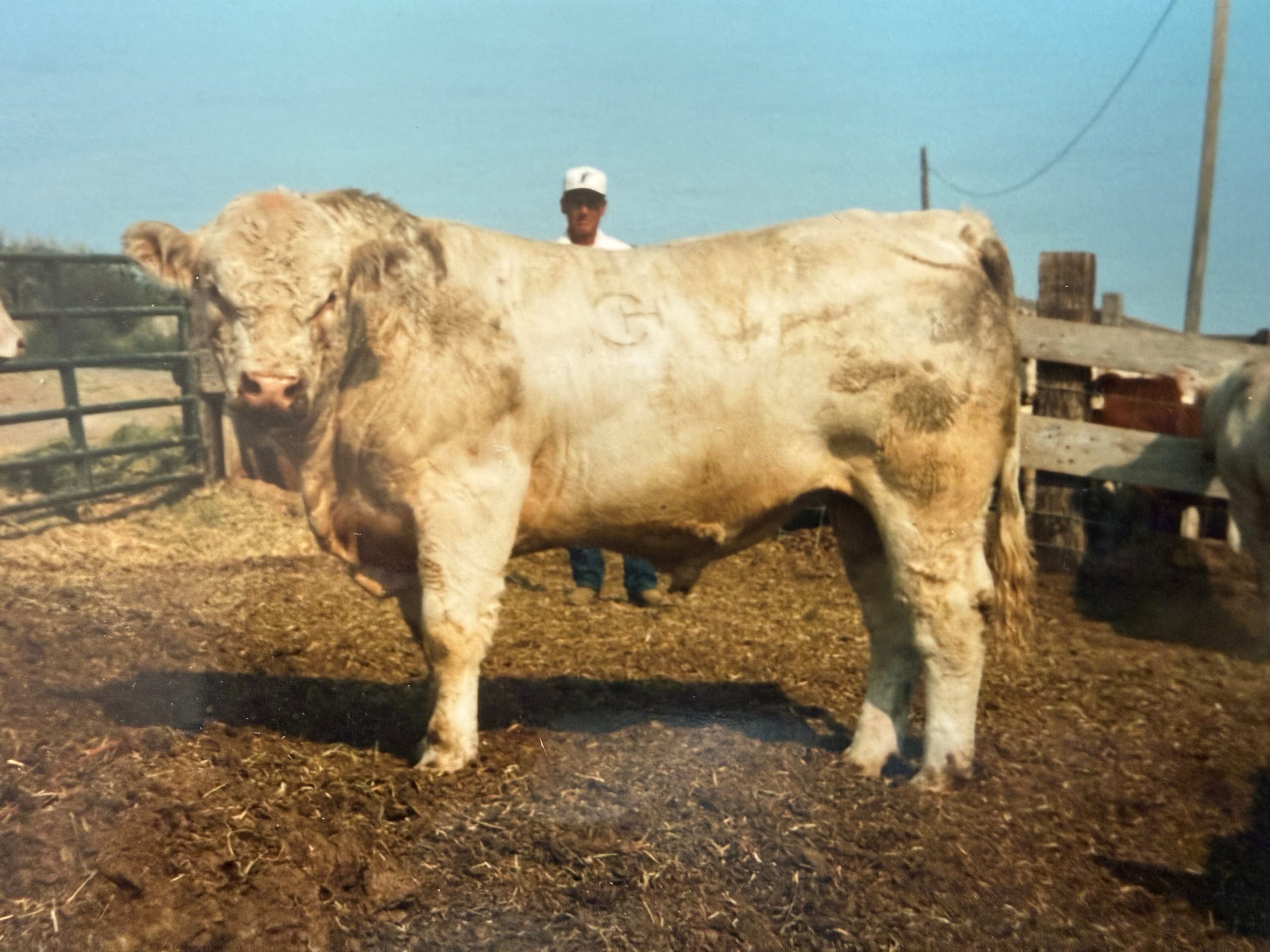
Jake with one of his Charolais on the family ranch near Valley Ford.
In 1977, Anna’s parents, Elray “Ray” Jr. (also known as Jake ) and Julie, began raising their own beef on the family’s 43-acre ranch near Valley Ford. He expanded the family’s work in cattle, breeding Charolais and helping other ranchers build their herds. He became known not just for his knowledge, but for his honesty, a reputation that traveled with him to auctions across the Central Valley. Julie, like many generations before her, thrived in baking and canning. She made irresistible Danish cookies that the family still makes on holidays. Canned goods included anything local – peaches, pears and homemade apple sauces from Gravenstein’s. Berries were plentiful on the ranch and often found their way into many of the family favorite recipes.
At home, the ranch was rarely quiet. Trucks came and went. Gates opened and closed. Neighbors gathered to move cattle, lend a hand, or simply catch up. It was not just work happening there, it was community in motion. People showing up for each other, again and again.
That same spirit extended beyond their own ranch. In the 1970s, when a doctor and nurse moved to the area with the ambitious idea of starting a sheep milking operation, it was the local agricultural community that helped bring it to life. Neighbors showed up, lending time, knowledge, and labor to build out the farm and production facilities. That small, collective effort would grow into what is now Bellwether Farms, a well-known and beloved cheese producer rooted in the same spirit of collaboration.
For Anna, childhood unfolded in wide open spaces. She rode horses down country roads to visit friends, built forts out of whatever she and her siblings Kirsten and Jacob could find, and wandered creeks, making entire worlds out of the land around her. There was freedom in it, but never loneliness. Someone was always nearby, always watching out, even if you could not see them.
In Two Rock, where she grew up, community was not something you scheduled, it just existed. Small schools, shared routines, familiar faces. Many kids came from ranching families, but even those who did not were folded into it. Pancake breakfasts, chicken barbecues, Fourth of July celebrations, these were not just events, they were threads weaving people together year after year.
Because ranching, as Anna sees it, has never been only about raising cattle.
It is about holding something steady for the next generation. Making decisions not just for today, but for the future. It is about land that is cared for, not just used. Traditions that are lived, not just remembered.
In 2015, her grandparents conserved 491 acres of their 1200 acre ranch in Chileno Valley with the Marin Agricultural Land Trust. With increasing pressure to subdivide the land and both in their 90s, they felt a deep urgency to protect what they had stewarded for decades.
Four years later, the family worked with Sonoma County Ag + Open Space to conserve an additional 127 acres along Spring Hill Road and Chapman Lane, land once owned by her Uncle Walt and Aunt Arleen. As one of the first open spaces seen when heading west out of Petaluma, the property serves as a critical greenbelt and buffer against development. It is also home to a striking chert rock outcrop known as Cathedral Rock, a landmark for photographers and painters alike.
And over time, things have changed.
Anna has watched dairies disappear, fields shift into vineyards, and the cost of holding onto land climb higher and higher. Regulations have grown more complex. At the same time, there has been a renewed appreciation for local food, organic practices, and knowing where what we eat comes from. What was once ordinary is now something people seek out, protect, and try to reclaim.
Still, in places like Two Rock and Bodega, much of what she loves remains. Rolling hills. Grazing cattle. Open skies that feel unchanged.
For Anna, preserving that landscape is not just about scenery. It is about protecting a way of life, a culture built on connection, responsibility, and care.
That sense of continuity carries through even as chapters close and new ones begin. After her father passed in 2020, the family made the difficult decision to sell the Valley Ford ranch to Joey and Samantha Tresch. Today under their beef brand, Deer Valley Daughters, they continue to bring people together through occasional pop-up events, offering a new kind of gathering space rooted in the same landscape her family once worked. Down the road at Olympia’s Valley Farm, her old neighbors the Tresch Family, run a charming event venue, on land that has been in their family since 1905.
She sees that same enduring spirit in farmers markets, county fairs, and small agricultural businesses. These are more than places to shop or gather, they are where knowledge is passed down, where young people learn the value of hard work and where community stays rooted in something real. Supporting local, she says, is one of the simplest and most powerful ways people can help keep that story going.
Anna’s own path eventually led her beyond the ranch. Like many, she was encouraged to follow what called to her. Today, she works with foster youth, creating stability and care in a different way, but one that feels deeply connected to how she was raised.
Even so, there are moments when she looks back and feels a quiet pull. What once felt ordinary now feels rare. Almost fragile.
Ranchers today face real challenges, but she believes in the strength of community, in the importance of local food systems, and in the people who continue to care for the land day in and day out.
Her brother Jacob once put it simply, there is something special about driving through rolling hills, past working ranches, all the way to an undeveloped coast. It is a feeling you cannot quite replicate anywhere else.